



The fastest way to find truck drivers is often not a new job board. It is the applicants already sitting in your ATS who never got a timely follow-up.
The American Trucking Associations puts the driver shortage at roughly 78,000 drivers (Fleet Equipment), though some industry voices argue that number has been overstated (FreightWaves). Either way, most recruiting teams feel it the same way: more ad spend, more leads, and not many more hires.
This guide to truck driver recruiting covers where to find truck drivers, how to post truck driver jobs that convert, and why the biggest gain is usually re-engaging drivers who already raised their hand.
Where to find truck drivers
No single channel fills a fleet. Most carriers that hire well run four or five at once and track cost per hire by source.
| Channel | Best for | Watch out for |
|---|---|---|
| Driver-focused media and job platforms (like CDLLife) | Reaching experienced CDL drivers where they already spend time | Lead volume means little if follow-up is slow |
| General job boards | Broad reach and local drivers | Mixed lead quality and high competition for the same applicants |
| Social media ads | Targeting by region, equipment type and experience | Short attention spans; the apply step must be quick on a phone |
| Employee and driver referrals | Drivers who stay longer and fit your culture | Needs a clear, fast referral bonus payout |
| CDL schools and training programs | Building a pipeline of new entry-level drivers | Longer runway before they are road-ready |
| Veterans programs | Disciplined drivers, some with military CDL experience | Requires a defined process for credential transfer |
| Your own ATS | Drivers who already applied, stalled or went quiet | Usually the most ignored channel, and the cheapest one |
The last row is the one most recruiting teams skip. Every lead in your ATS was already paid for, so re-engaging those drivers lowers cost per hire without adding spend. See our full list of driver recruiting strategies.
How to post truck driver jobs that convert
A truck driver job post should answer the five questions a driver asks before applying, in the first few lines: pay, home time, route, equipment and requirements.
- Lead with pay. Give a real range, CPM or weekly figure, plus sign-on or referral bonuses.
- Spell out home time. "Home weekly" or "out 2 weeks, home 3 days" beats "great home time."
- Name the route and freight. OTR, regional or local; dry van, reefer, flatbed or tanker.
- Describe the equipment. Truck age, automatic or manual, and any tech in the cab.
- List requirements plainly. CDL class, years of experience, endorsements and any record limits.
- Make applying fast on a phone. A short first step that captures contact details, with the full application after.
- Say what happens next. "A recruiter will call you within the hour" sets an expectation, and then you have to meet it.
That last step is where most posts lose the driver. A great job post fills the top of the funnel; it cannot save a driver who waits days for a callback.
Why truck drivers ghost recruiters
Drivers rarely ghost because they lost interest. They ghost because another carrier called first.
Tenstreet's analysis of more than 1.5 million drivers found that carriers responding to an application within five minutes hire at 6.2%, nearly double the 3.7% average. When the hiring process runs past 10 to 15 days, hiring rates drop by up to 50% (DC Velocity, June 2025). CDLConnect's own research found 72% of drivers are frustrated with the recruiting process.
Drivers fall out at every stage, and each stage has its own cause:
- Clicked the ad, never started: a slow or clunky first touch.
- Started the application, never finished: a long form and no follow-up.
- Finished the application, never talked to a recruiter: waited too long for a call.
- Talked to a recruiter, never hired: went quiet mid-process, often hired elsewhere.
Only 6 of every 100 drivers who click a job ad get hired (illustrative)
| Clicked the ad |
|
100% |
| Started application |
|
58% |
| Finished application |
|
31% |
| Talked to a recruiter |
|
17% |
| Hired |
|
6% |
The biggest drops happen before a driver ever talks to a recruiter, which is where fast, automated follow-up pays off most.
Count your ghosts: what driver drop-off really costs
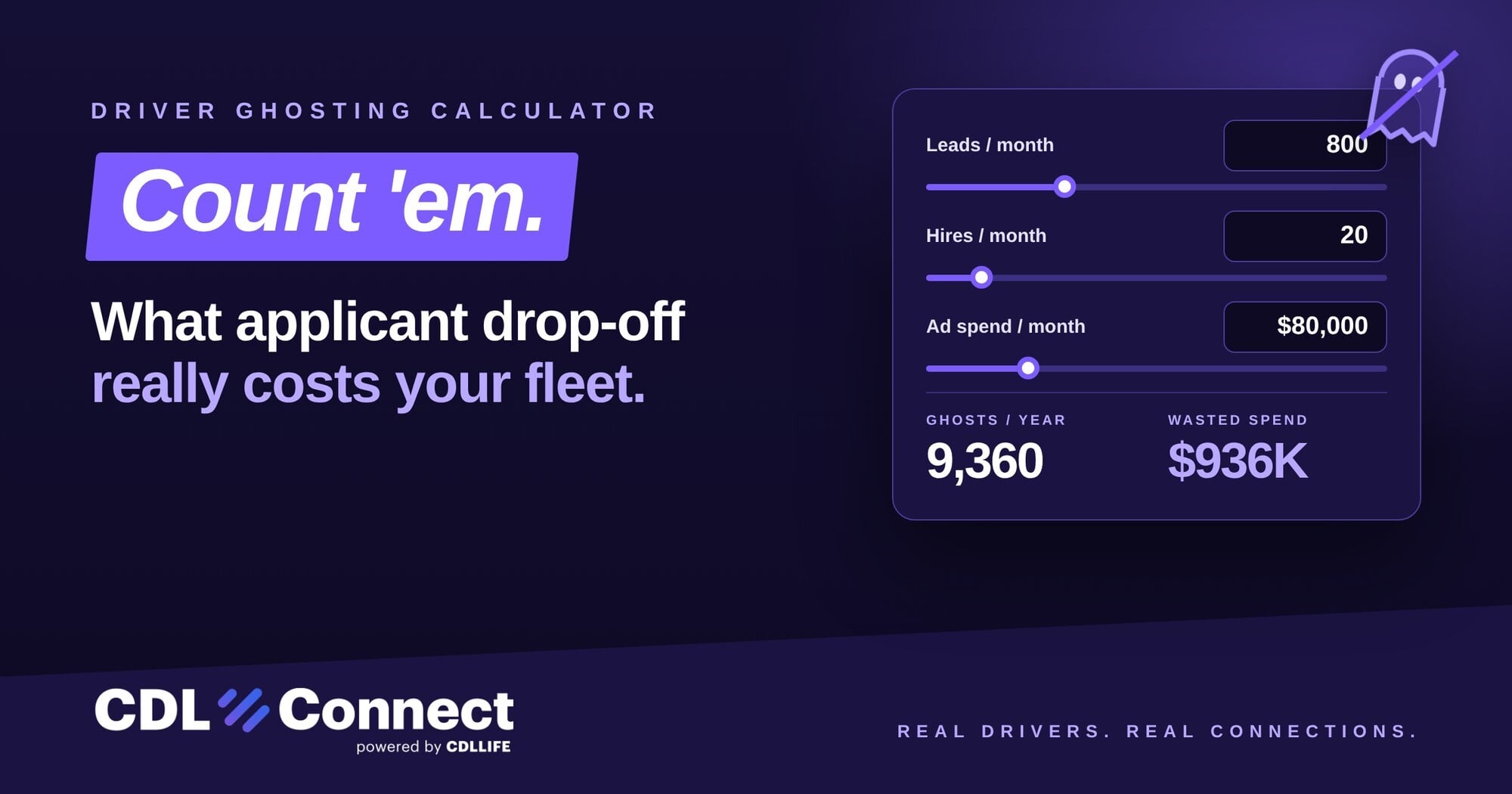
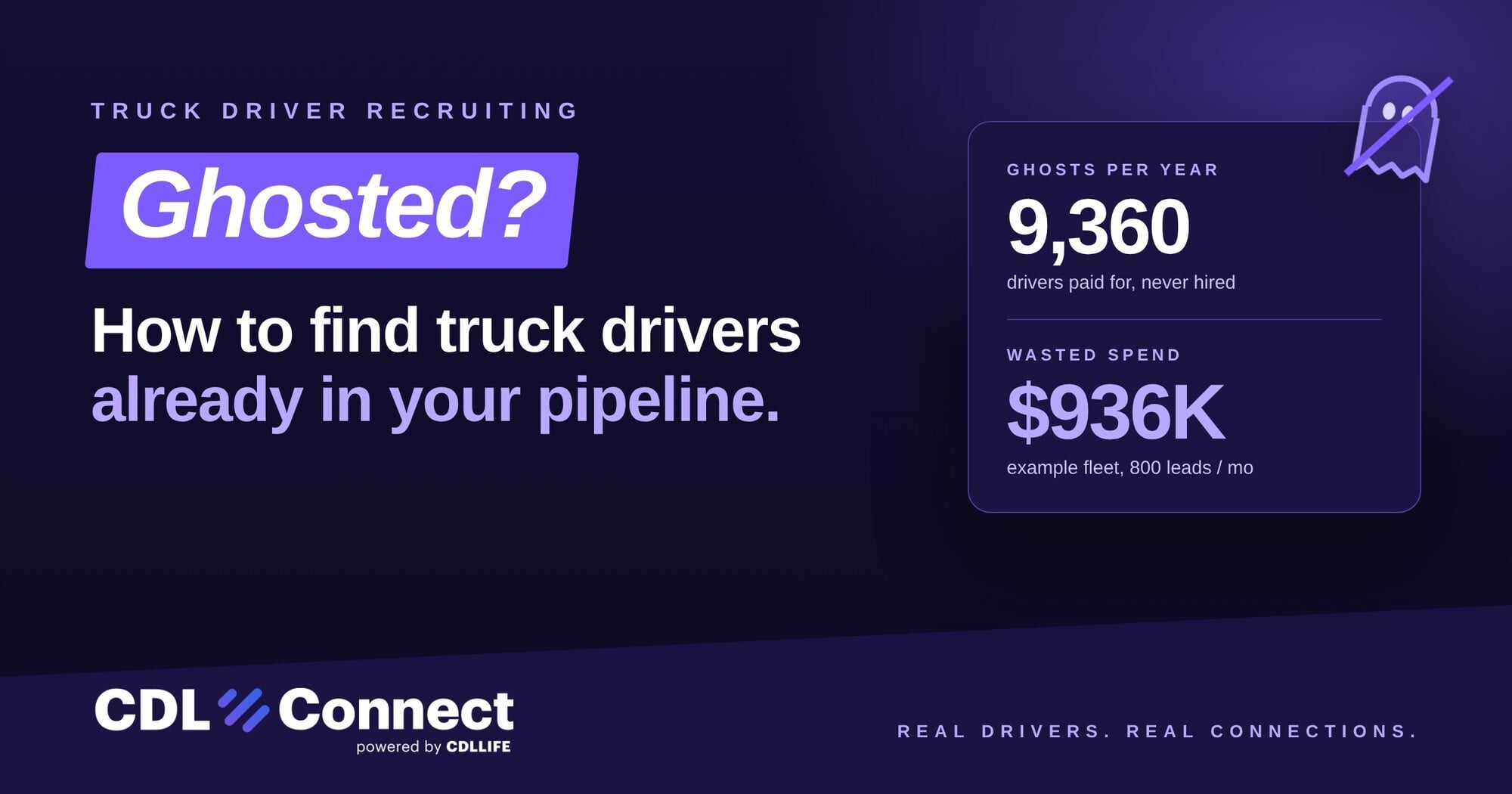
A fleet that gets 800 driver leads and makes 20 hires a month on an $80,000 budget pays for 9,360 drivers a year it never hires. That is $936,000 in recruiting spend.
The math takes three numbers your recruiting team already knows:
- Ghosts per year = (leads per month − hires per month) × 12
- Wasted spend = ghosts per year × cost per lead (monthly ad spend ÷ leads per month)
In the example, (800 − 20) × 12 = 9,360 ghosts, and the cost per lead is $80,000 ÷ 800 = $100. Win back just 1 in 100 of those drivers and that is about 94 more hires a year on the same budget, taking cost per hire from $4,000 to about $2,874.
Want the full breakdown, with examples by fleet size? Read Driver Ghosting Calculator: What Applicant Drop-Off Costs Your Fleet.
Free ghost calculator
How many drivers have you paid for and lost?
Plug in three numbers and see your ghost count and wasted spend. Takes 20 seconds. No email required.
Count My Ghosts →How to re-engage truck drivers already in your ATS
Re-engaging drivers you already paid for is the cheapest hire in truck driver recruiting, because the lead cost is already spent.
- Respond in minutes, not days. Tenstreet's data shows a five-minute response nearly doubles the hiring rate. Automate the first touch so no applicant waits on a recruiter's schedule.
- Segment by where they stalled. A driver who stopped at 80% of the application needs a different message than one who stopped answering after the first call.
- Follow up more than once. One voicemail is not a follow-up. Use a short sequence across text, email and phone over several days.
- Keep the message about them. Lead with pay, home time and route, and make the next step one tap.
- Re-open old leads regularly. Drivers who passed six months ago may be ready to move now.
- Track recruiter follow-up speed. Measure time to first contact and cost per hire by source, so you know which channels and habits actually produce drivers.
This is what CDLConnect's Driver Journeys does automatically: it spots when a driver goes quiet, sends follow-up tailored to the stage they stalled at, and plugs into the ATS you already run. CDLConnect customers have seen 60% of drivers recovered, a 145% increase in hires and a 17% lower budget.
Truck driver recruiting FAQ
How do I find truck drivers fast?
Run several channels at once (driver-focused platforms, job boards, social ads and referrals) and respond to every applicant within minutes. Then re-engage drivers already in your ATS, since they are the fastest and cheapest hires available.
Where is the best place to post truck driver jobs?
Post where CDL drivers already spend time: driver-focused media and job platforms, plus general job boards and social ads for reach. Track cost per hire by source and shift budget to what produces drivers, not just leads.
What should a truck driver job posting include?
Pay, home time, route type, freight and equipment, and clear requirements, all near the top. Keep the first apply step short and mobile-friendly.
Why do truck driver applicants stop responding?
Most go quiet because the process was slow, not because they lost interest. Carriers that respond within five minutes hire at nearly double the average rate.
How do I calculate the cost of driver ghosting?
Subtract monthly hires from monthly leads, multiply by 12, then multiply by your cost per lead. The free ghost calculator does it in 20 seconds.
Your next hire is already in your pipeline
Before you spend more to find truck drivers, find out how many you have already paid for and lost.
Free ghost calculator
Count your ghosts, then go get them back.
See your number in 20 seconds, then book a 20-minute demo to see exactly where your drivers are dropping off and how Driver Journeys brings them back.
Run My Numbers →